Winter construction across Lucas County presents severe subgrade challenges, particularly along the heavy clay soils near Point Place, East Toledo, and Reynolds Corners where frost depths regularly reach 24 to 36…
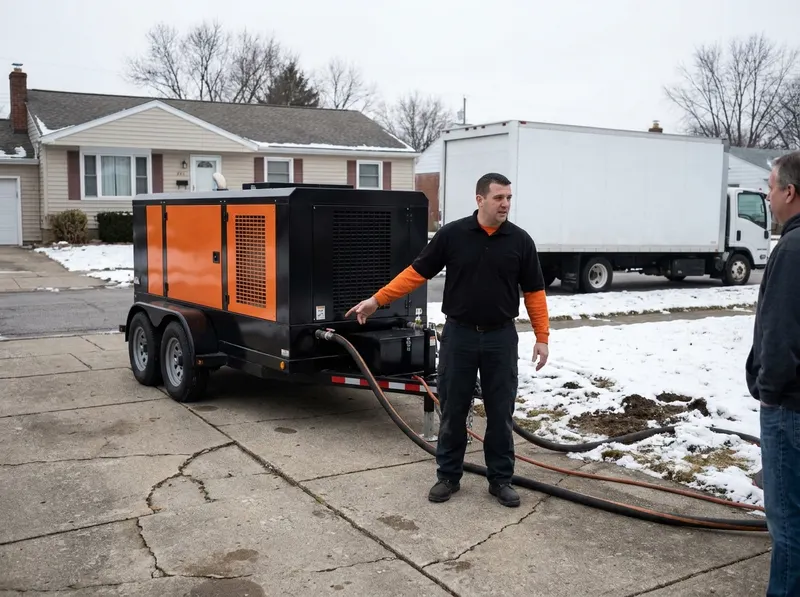
Winter construction across Lucas County presents severe subgrade challenges, particularly along the heavy clay soils near Point Place, East Toledo, and Reynolds Corners where frost depths regularly reach 24 to 36 inches between December and March. A hydraulic ground thaw unit pumps heated propylene glycol through heavy-duty hoses laid across the ground, transferring heat through moisture-trapping plastic and multi-layer thermal blankets. Unlike open-flame indirect blowers that lose up to 80% of their heat energy to lake-effect winds coming off Maumee Bay, closed-loop hydraulic heaters drive warmth downward into the soil structure. A 1,200-foot hose system typically thaws a 2,400-square-foot footprint in 36 to 48 hours, keeping small contractors and commercial builders on schedule without burning excess fuel.
Selecting the correct thawing profile depends directly on project requirements. A standard 150,000 to 300,000 BTU unit efficiently thaws 1,200 to 6,000 square feet for footings, grade beams, and utility taps in older districts like the Old West End, Five Points, and the Warehouse District. Larger multi-pump machines covering up to 9,000 square feet serve larger parking structures and industrial foundation pours near Franklin Park and Beverly. If the job involves a shallow trench or basic pad, spaced hose loops at 12 to 16-inch centers achieve thaw temperatures rapidly. If the job involves curing freshly placed high-early concrete, placing hose runs directly over vapor retarders prevents localized thermal cracking by maintaining steady 65-degree curing conditions. The primary trade-off comes down to site setup time versus heating speed: hydraulic setups require manual hose routing and weighted tarp anchoring against Toledo gusts, but they eliminate dry-out risks and eliminate the carbon monoxide accumulation risks inherent to vented space heaters.
Operational steps follow a clear order for field crews. 1. Grade the target surface clear of deep drift snow using a basic skid steer to expose direct subbase. 2. Loop the hydraulic heat transfer lines across the grid using even 12 to 18-inch offsets. 3. Cover the active grid with 6-mil poly vapor barrier followed by insulated r-value curing tarps staked at 6-foot intervals to trap Lake Erie gusts. 4. Connect the manifold couplers, verify line pressure on the digital gauge, and initiate burner ignition on the digital control module. The continuous fluid circulation maintains ground surface temperatures between 70°F and 110°F, transforming solid frozen subsoil back into workable earth so excavation and pour crews maintain standard production rates without winter shut-downs.
Every job gets a firm, written price after a free on-site visit.
Tell us about your hydraulic ground heater & thawing unit rentals job in Toledo and we'll send a clear, written quote, usually the same day.
 Load & Go Dumpster Rental