Temporary job site power keeps framing crews, masonry mixers, and commercial drying operations running when utility hookups along Toledo corridors remain unenergized. In dense industrial pockets like the Warehouse…
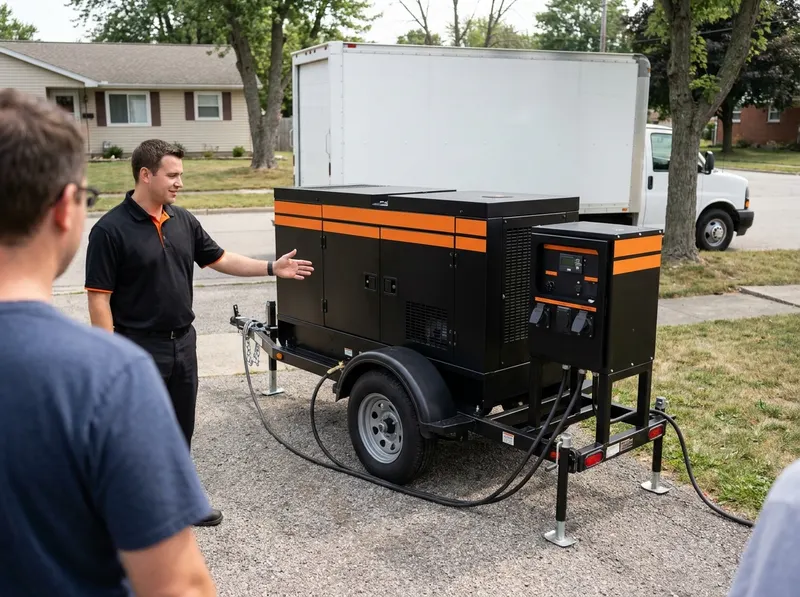
Temporary job site power keeps framing crews, masonry mixers, and commercial drying operations running when utility hookups along Toledo corridors remain unenergized. In dense industrial pockets like the Warehouse District or large commercial plazas near Franklin Park, utility drop delays from local providers can stall schedules by weeks. Towable diesel generators bridge that gap by delivering stable single-phase 120V/240V or three-phase 208V/480V electricity directly to site distribution boxes, eliminating the voltage drop and breaker trips caused by daisy-chaining standard extension cords over 100 feet. Heavy equipment transports utilize wood cribbing and rubber tire pads to prevent concrete cracking or asphalt impressions on finished parking surfaces during drop-off.
Selecting the right setup depends on total running amperage versus motor-starting surge wattage. A compact 25 kVA unit reliably powers temporary trailer offices, tool chargers, and small air compressors for residential builds in Five Points or Beverly, but it lacks the inductive surge capacity required for commercial mortar mixers, tower cranes, or desiccant dehumidifiers. For heavy commercial restorations along the Maumee River in East Toledo or industrial docks in Point Place, a 70 kVA to 150 kVA mobile plant provides the high continuous amperage needed without risking brownouts. The operational trade-off centers on fuel consumption versus output capacity: higher-kilowatt generators consume significantly more diesel per run hour under partial loads, making proper load-banking and precise kilowatt sizing critical to maintaining operational efficiency.
Site configuration follows clear safety protocols to handle wet regional conditions near Lake Erie. 1. Delivery trucks position the towable generator on level ground at least 20 feet away from combustible materials and building fresh-air intakes. 2. Technicians drive a dedicated copper-clad grounding rod into the soil to ensure complete fault protection according to local electrical codes. 3. Technicians run heavy-duty 4/0 feeder cables with color-coded cam-lock fittings to a main distribution panel. 4. Weather-resistant 50-amp feeder cables route electricity from the central panel out to 20-amp GFCI quad boxes positioned across the trades' work zones. This modular spider-box layout ensures that subcontractors in historic West Toledo or Old West End renovations work from safe, isolated circuits that prevent site-wide blackouts if an individual hand tool faults.
Every job gets a firm, written price after a free on-site visit.
Tell us about your commercial site generator & power distribution rentals job in Toledo and we'll send a clear, written quote, usually the same day.
 Load & Go Dumpster Rental